RESTORATION, PRESERVATION & ARCHIVING
MENU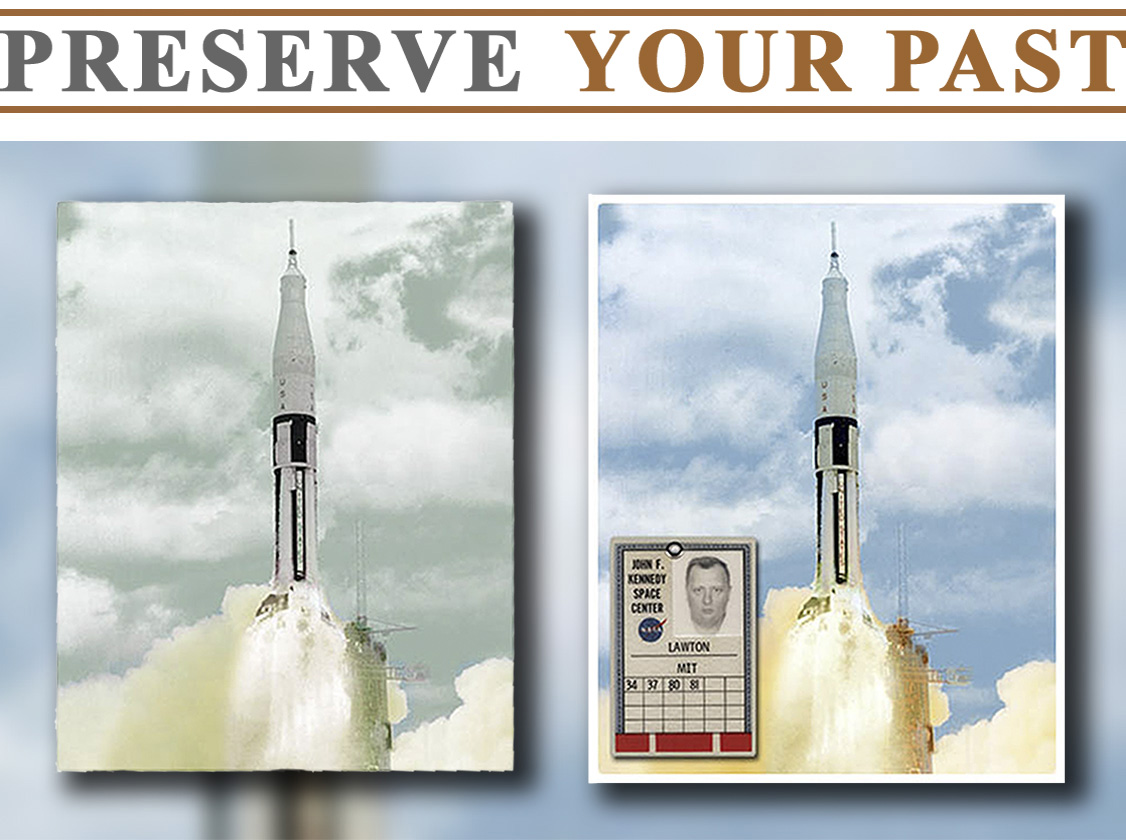
RESTORATION OF AN APOLLO SPACE PROGRAM MEMORABILIA PHOTOGRAPH
The second half of the 20th century was defined by the Cold War, a decades-long geopolitical, ideological, economic, and military rivalry between the United States and the Soviet Union. One of the most visible and consequential arenas of this competition was the race to explore and master outer space.
On October 4, 1957, the Soviet Union successfully launched Sputnik 1, the world’s first artificial satellite, into Earth’s orbit. The achievement shocked the United States and challenged American assumptions about technological and scientific leadership. The launch demonstrated Soviet advances in rocket technology and intensified concerns that the United States was falling behind in a critical area of modern innovation.
Determined to meet this challenge, President John F. Kennedy called for an ambitious American space program. After consultations with scientists, engineers, and government advisors, the United States established a bold national objective: to send a human being to the Moon and safely return him to Earth before the end of the decade. Announced in 1961, this unprecedented undertaking became known as Project Apollo, one of the most ambitious engineering achievements in human history.
 On December 21, 1968, Apollo 8 launched from the John F. Kennedy Space Center in Florida, becoming the first crewed spacecraft to escape Earth’s orbit, travel to the Moon, orbit it, and safely return. The mission carried astronauts Frank Borman, James Lovell, and William Anders, who became the first humans to witness the Earth rising above the lunar horizon. Their iconic photograph, known as “Earthrise,” became one of the most influential images of the 20th century, transforming humanity’s perception of its place in the universe.
The success of Apollo 8 was made possible by the dedication of thousands of scientists, engineers, technicians, and support personnel who contributed their expertise to the program. Their achievements were recognized through awards, commemorative items, and official NASA memorabilia. Although strict security regulations governed many aspects of the space program, NASA employees and contractors were often able to preserve personal mementos connected to their work , tangible reminders of their participation in one of mankind’s greatest technological endeavors.
Official mission photographs, launch images, mission patches, identification badges, pins, and other artifacts became treasured family heirlooms and highly valued collectibles among space memorabilia enthusiasts. These objects serve not only as historical records but also as personal connections to the people who helped make space exploration possible.
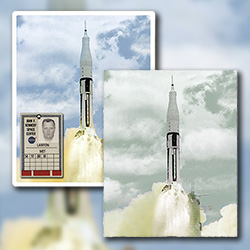
The faded photograph featured in this restoration project was brought to us by the family of an engineer who worked for many years on NASA’s space program. The original image captured the dramatic moment of the Apollo 8 Saturn V rocket launch from Cape Canaveral, with the powerful spacecraft rising above the Florida coastline on its historic journey toward the Moon.
The damaged and faded photograph was carefully restored through digital preservation techniques, including detailed retouching, removal of age-related deterioration, and color correction to recover the original contrast, depth, and vibrancy of the image. The restored launch photograph was then combined with a reproduction of the engineer’s NASA identification badge, creating a personalized commemorative collage.
The finished piece became a unique and meaningful birthday gift - honoring not only the Apollo program itself but also the dedication of the engineers, technicians, and countless individuals whose contributions helped humanity reach beyond Earth.
|
|
|
|

|

|
|

|
|
|

|
|
|
|
|
|
|
|
|
|
|
|
|
|
|
|

|
|
|
|

|
|
|
|
|
|
|
|
|
|
|
|
|
|

|
|
|||||||||
| © 2026 Preserve Your Past | |||||||||
| By accessing this website you signify that you read, understood, and agreed to be bound by Terms of Services. If you do not agree to these terms, you are not permitted to use the Services. These Terms of Services have the same force and effect as an agreement in writing. |
|||||||||


