RESTORATION, PRESERVATION & ARCHIVING
MENU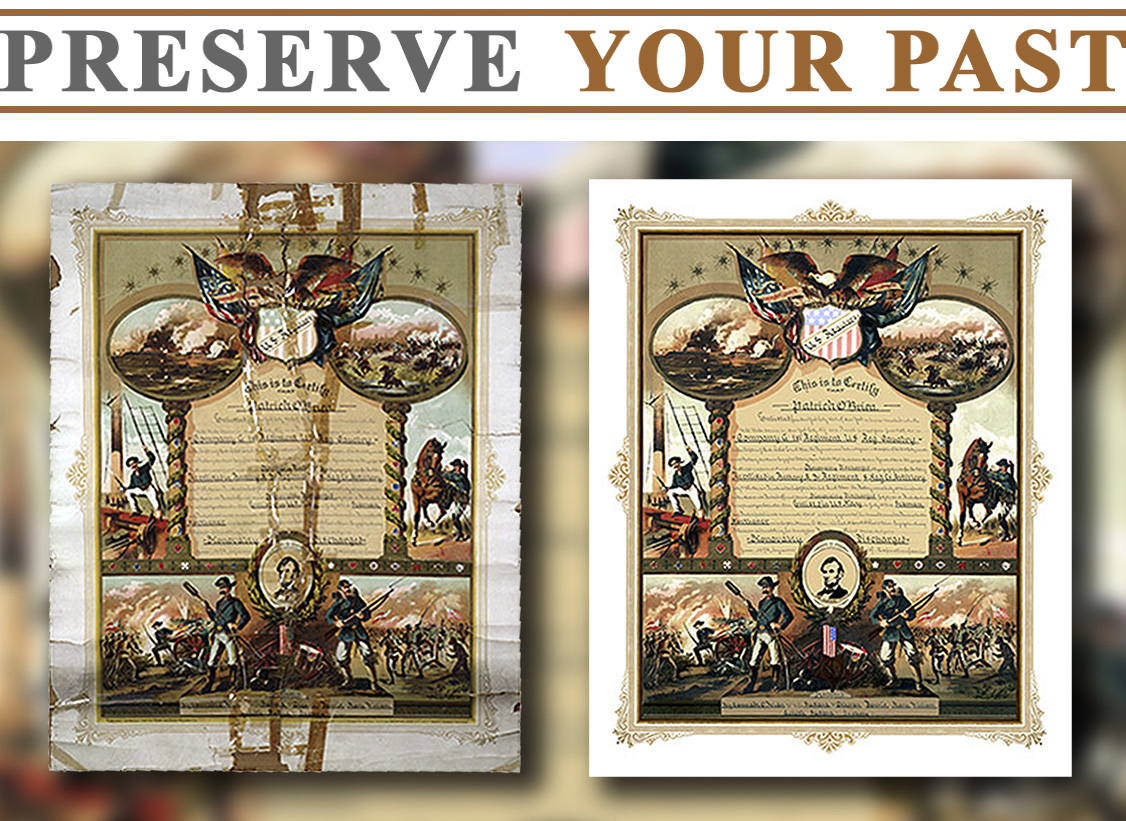
Restoration of a Commemorative Civil War Union Army Certificate of Discharge
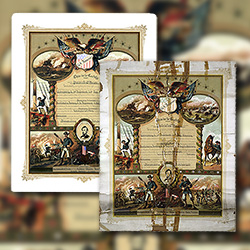
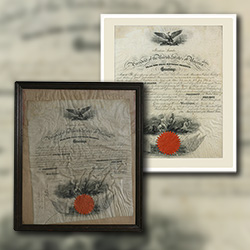
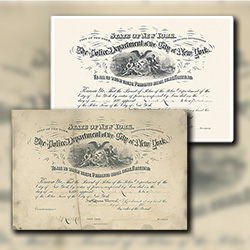
This beautiful commemorative military certificate honoring a Union Army veteran provides a remarkable glimpse into the service and sacrifice of a generation that fought during one of the most defining periods in American history. The certificate records the veteran's military service, including the engagements in which he participated, the regiments in which he served, and the commanding officers under whom he fought during the American Civil War.
 Unlike an official military discharge document issued at the time a soldier left the Army, this piece was a later commemorative certificate, created to honor the veteran and commemorate the passage of time since the Civil War. It was presented to the veteran on the 20th commemoration of the conflict, making it both a tribute to his military service and a valuable piece of American and family history.
For the veteran and his descendants, however, the certificate had survived the decades in extremely poor condition.
Over the years, this important historical document had suffered a tremendous amount of damage. Dust and soot had accumulated on its surface, while numerous creases, tears, and stains had compromised both its appearance and structural stability. Chemical staining had further discolored portions of the paper.
The most serious damage, however, resulted from an earlier attempt to repair the certificate using adhesive tape. Although the intention was presumably to save the damaged document, the tape had unfortunately become one of the greatest threats to its long-term preservation. Over time, adhesive tapes can discolor, become brittle, stain paper, and create additional stresses as they age. In some cases, removing old tape can be as dangerous as leaving it in place, particularly when the adhesive has bonded tightly to fragile paper fibers.
The restoration therefore required patience, precision, and a conservative approach. The primary goal was not simply to make the certificate look new again, but to stabilize the original document while preserving as much of its historic material as possible.
 The first stage of the restoration involved carefully cleaning the surface of the certificate to remove accumulated dirt and debris. The document was examined closely, and as much of the old adhesive tape as could be safely removed was carefully lifted from both the front and back of the piece without causing additional damage to the fragile paper.
Because aged paper can become extremely brittle, every step of the treatment had to be performed with great care. Excessive pressure or aggressive removal of the tape could have resulted in the loss of original paper fibers, printed information, or portions of the certificate itself.
Once the surface had been cleaned and the most damaging materials removed, the certificate was carefully flattened. Years of improper storage and handling had left the paper severely creased and distorted. The creases were gently reduced as part of the stabilization process, helping to restore the document to a flatter and more stable condition while avoiding unnecessary stress on the weakened paper.
The numerous tears were then carefully reinforced using Japanese tissue paper, a lightweight and strong conservation material widely used in the preservation of historic paper documents. Properly applied, Japanese tissue can provide support to weakened areas while remaining relatively unobtrusive and allowing the original document to retain its historic character.
After the certificate had been cleaned, flattened, repaired, and stabilized, a high-resolution archival-quality digital scan was created. This step was particularly important because it created a detailed digital record of the historic artifact while also making it possible to produce faithful reproductions without repeatedly handling the fragile original.
Several high-quality reproduction copies were subsequently printed on fine art paper. These reproductions were created to be presented as gifts to the veteran's descendants, allowing family members to enjoy and share the story of their Civil War ancestor while reducing the need to handle the original commemorative certificate.
Documents such as this are more than pieces of old paper. They are tangible connections to the people who came before us and to the events that shaped the history of a nation. For the family of this Union Army veteran, the certificate preserves a record of military service that might otherwise exist only in historical records and family memories.
The restoration not only gave this remarkable commemorative certificate a new lease on life, but also helped ensure that its story could continue to be shared with future generations. Through careful conservation, high-resolution digital preservation, and archival-quality reproduction, an important piece of American and family history can now be protected, enjoyed, and remembered for many years to come.
|
|
|
|

|
|
|
|
|
|
|
|
|
|
|
|
|
|
|
|
|
|
|
|
|
|
|
|
|
|
|
|
|
|
|
|
|
|
|
|
|
|

|
|
|
|
|||||||||
| © 2026 Preserve Your Past | |||||||||
| By accessing this website you signify that you read, understood, and agreed to be bound by Terms of Services. If you do not agree to these terms, you are not permitted to use the Services. These Terms of Services have the same force and effect as an agreement in writing. |
|||||||||


